
This Year’s Daring Seder Deviation
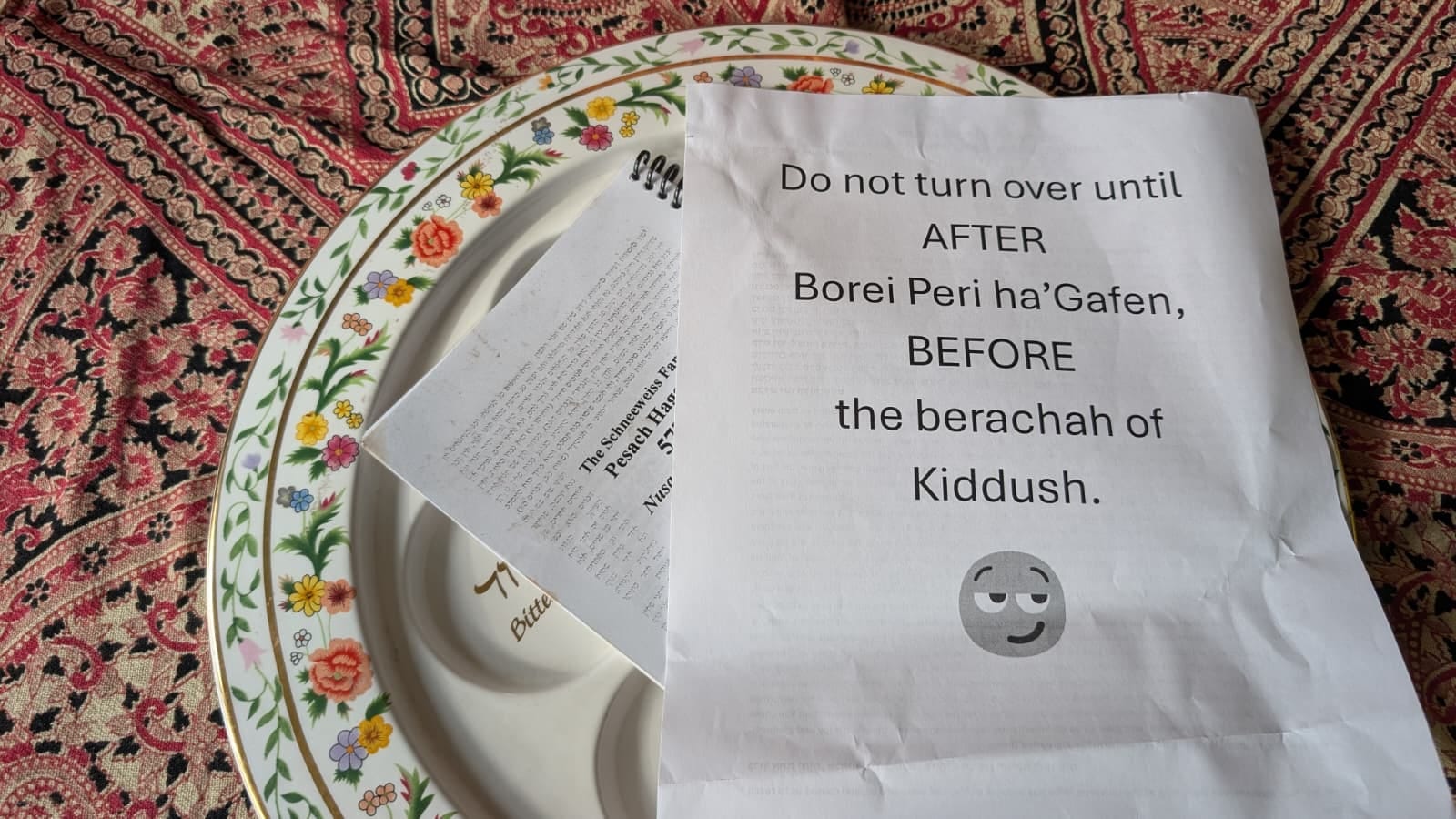
In this belated Pesach article, I describe a radical shinui I introduced at our seder - so radical that I’ve put most of the piece behind a paywall. But rest assured: I have Saadia Gaon's permission!

A link to a printer-friendly version of the full article can be found at the very end, for paid subscribers only.
The Torah content for the month of Nisan has been sponsored by Rivkie and Dovi Siderson. In the merit of our learning, may Hashem help us use this time to cleanse ourselves of spiritual “chametz,” bringing refuah, shalom, and the final geulah to all of Klal Yisrael!
This Year’s Daring Seder Deviation
Shinuyim at the Seder
Rambam (Hilchos Chametz u’Matzah 7:3) codifies a halacha that, in my opinion, doesn’t get nearly enough press:
One must introduce a shinuy (change) on this night so that the children will see and ask and say, “How is this night different from all other nights?” until he responds to them and tells them, “Such and such happened” and “Such and such was.” How does he change? He distributes to them roasted kernels and nuts, and they take away the table from in front of them before they eat, and they snatch matzos from each other’s hands, and similar things. If he has no son, his wife asks him. If he has no wife, they ask each other, “How is this night different from all other nights?” — even if all of them are wise. If he is by himself, he asks himself, “How is this night different from all other nights?”
These shinuyim aren’t meant to be formulaic or ritualistic. That would defeat the purpose. Rather, they’re supposed to be genuine deviations from the norm that prompt the kids to sense that something is different about this night and to ask out of genuine curiosity.
The shinuy doesn’t even need to be thematically related to Pesach, so long as it prompts the kids to ask a question the seder leader can use as a segue into sipur Yetzias Mitzrayim (telling the story of the Exodus from Egypt). This is clear from the Rambam’s examples and from the anecdote told by the Rav (Rabbi Joseph B. Soloveitchik) about how his grandfather, Rav Chaim Soloveitchik, came to the table wearing a pot on his head. I shared my take on the philosophy behind this halacha in one of my very first Pesach-themed articles, written in 2012: Karpas: The Masorah of Intellectual Courage.
From the classical sources, it seems that such shinuyim are only halachically required at a seder with young children who will “fall for” the ruse. However, I believe an argument can be made from the Rambam’s inclusion of the clauses “If he has no son” and “If he has no wife” that introducing shinuyim to prompt questions from anyone would be at least a philosophical kiyum (fulfillment) of this halacha, if not a halachic one. For this reason, over the twenty-four years I’ve been leading our sedarim, I’ll sometimes introduce my own shinuyim to prompt our guests to ask.
This year, I introduced the biggest shinuy yet. Although I’m convinced I have ample justification for what I did, some will deem it halachically radical, which is why I’m keeping the rest of this article behind a paywall.
